Sustainable buildings are constructions adapted to the environment, whose design aims to reduce energy dependence by making use of the energy potential offered by the surrounding climate.
A sustainable building is one that adapts to its environment and takes advantage of it—solar radiation, air currents, etc.—providing the same level of comfort for its occupants while consuming significantly less energy than usual.
Reducing energy consumption in buildings not only lowers economic costs for users, but also decreases the pollution associated with energy production and reduces dependence on limited fuels.
One of the first factors that helps reduce energy expenditure is conservation. If we manage to conserve energy, we reduce the need for it. There are different ways to conserve energy in buildings.
Thermal insulation in enclosures reduces heat loss through them to one quarter. There are currently different materials designed for each situation—for cavity injection, external insulation, etc.—so all building components should be insulated. Proper insulation prevents thermal bridges or heat leaks, which are responsible for 20% of the energy lost in buildings. To prevent them, it is advisable to avoid reductions in wall thickness and to use compact roller shutter boxes and window frames. It is also advisable to combine insulation with a vapour barrier to avoid condensation in the inner layers of the enclosures.
The thermally weakest points of buildings are glazed openings. For this reason, choosing the right frames and glazing is essential. The use of double glazing or insulated glass significantly reduces energy losses and provides excellent acoustic insulation. In addition, airtight window frames prevent leaks. For glazed openings exposed to continuous solar radiation, low-emissivity glass, reflective glass or tinted panes can be used.
The second aspect is the free capture of energy from the environment, which generally involves the use of renewable energies, although there are also strategies for achieving natural heating or cooling.
There are currently various standards and certifications—such as PassiveHaus, LEED, and BREEAM—whose compliance guarantees that certified buildings are efficient in the use of resources such as energy and water.
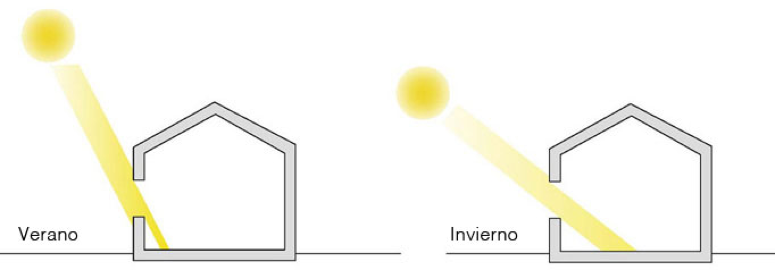
These strategies essentially consist of harnessing solar radiation in winter to heat the interior of buildings. The main strategy is the proper orientation of glazed openings, taking into account the necessary protection to prevent excessive heat gains in summer. The optimal orientation is south, as it receives the most radiation. Proper sizing of the openings allows the winter sun—lower in the sky—to penetrate deeper into the rooms, while in summer, being higher, its angle of incidence is reduced and penetration is lower.
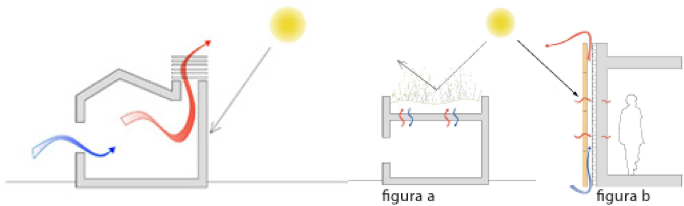
La principal estrategia consiste en evitar y eliminar el sobrecalentamiento mediante la ventilación fundamentalmente. Existen mecanismos para forzar de una forma natural la ventilación, como son las chimeneas solares. El aire caliente tiende a subir, puesto que es más ligero que el aire frío. Si colocamos una apertura superior (chimenea) en un punto del interior, preferiblemente en la fachada sur, que es donde más calor se concentra, y una abertura inferior, como una ventana en la cara norte, se producirá un movimiento de aire que refrescará la vivienda.
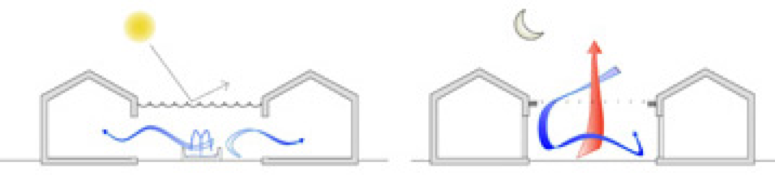
Otra estrategia de enfriamiento es la que se emplea en los conocidos como patios andaluces o la Alhambra en Granada. Estos patios embolsan aire enfriado durante la noche, de forma que durante el día intercambie calor con las estancias que lo rodean. Hasta que el aire no se ha calentado, no escapa del patio por convección, enfriándose de nuevo durante la noche. Este sistema se complementa con la colocación de fuentes o láminas de agua, que se evaporan aportando mayor frescura al ambiente.
El sistema de fachada ventilada permite un mejor comportamiento térmico del interior. Consiste en la creación de una cámara ventilada intermedia entre las hojas del cerramiento de un edificio, de forma que el aire frío penetra por la parte inferior, se calienta absorbiendo el calor producido por la radiación solar, y sale por la parte superior.
El sistema de cubiertas vegetales o agua embolsada en cubierta, permite la absorción diurna del calor interior del edificio que disipa durante la noche.