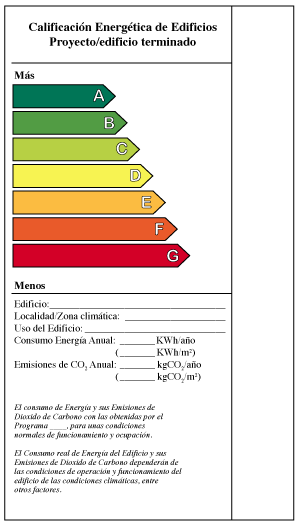
The energy certification of buildings aims to present the energy performance of buildings in a clear and understandable way for users and property buyers.
It is a label comparable to the energy rating found on household appliances, classifying energy efficiency from A, the most efficient, to G, the least efficient.
Currently, it is a mandatory requirement for newly constructed buildings and major refurbishments, as well as for certain existing public buildings, and whenever a property is to be rented or sold.
To obtain the energy certification, the building’s energy demand must be calculated at the project stage through a theoretical model. This calculation takes into account total electricity consumption based on the characteristics of the envelope, ventilation and orientation, indoor and outdoor environmental conditions, the presence of passive solar systems and solar protections, and the heating, domestic hot water, air conditioning and lighting systems. This process results in a provisional energy certificate. During construction, it is verified whether the building’s actual energy performance matches the simulated one. If necessary, data are adjusted to achieve the appropriate rating, and the final certificate is issued.
This certificate must be included in the Building Logbook and is valid for 10 years, after which the building must be re-certified.
In addition to the certification, the label displays information regarding the building’s location and climate zone, its use, its primary energy consumption in kWh/year, its annual CO₂ emissions, as well as the same data per square metre of floor area.
It is important to note that energy certification only allows comparisons between buildings with similar characteristics, just as with household appliances. This means that a building with an A rating may consume more energy than a smaller building with a C rating that requires far fewer installations.
The headquarters of the company Gioseppo is an example of sustainable and energy-efficient architecture. Its design combines energy production systems—such as photovoltaic panels and solar thermal systems—with passive energy-saving strategies typical of bioclimatic architecture.
In addition to providing an aesthetic function, the double skin that forms the building’s façade becomes a key element for controlling both light and interior temperature. The outer layer is made of micro-perforated steel sheeting, which acts as a solar filter, retaining excess solar radiation and transforming it into pleasant, diffused light. The inner layer consists of large glass windows, with an exterior perimeter corridor located between the two skins.
In this corridor, convection currents are generated that carry hot air upwards and expel it through the top of the building. This creates a thermal buffer that regulates indoor temperatures in both winter and summer conditions, reducing the energy required for heating and cooling.
Inside the building, the creation of a central courtyard—whose opening adapts to the needs of each floor—also responds to several functional criteria. On the one hand, this courtyard acts as a thermal chimney, facilitating air movement by convection; on the other, it allows natural light to reach all workspaces in the company, resulting in significant savings in electric lighting.
These strategies are complemented by the inclusion of rainwater collectors, which supply the building’s sanitation and irrigation systems.
This building demonstrates how it is possible to create a functional, aesthetically pleasing and comfortable workspace while also being environmentally responsible.
If you believe that your home or business is an example of sustainable building, contact the Provincial Energy Agency and we will publish it on our website.